> For the complete documentation index, see [llms.txt](https://docs.ultramarinastudios.com/llms.txt). Markdown versions of documentation pages are available by appending `.md` to page URLs; this page is available as [Markdown](https://docs.ultramarinastudios.com/sections/multicolumn.md).

# Multicolumn

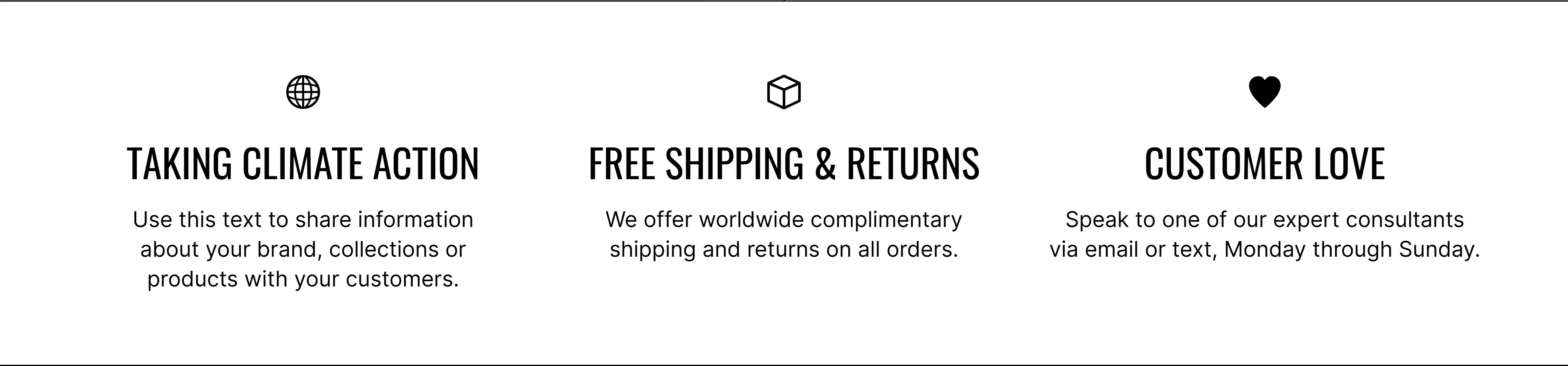
<figure><img src="/files/otfRVwcqP08INy3apY10" alt=""><figcaption><p>Multicolumn section with icon, heading and text blocks</p></figcaption></figure>

{% hint style="success" %}
**Quick start**

* Click into each **column** and edit the nested **heading**, **text** or **button** blocks — or add new blocks such as **icon** or **image**.&#x20;
* To add a new column, hover over the area where you'd like to add it, click the plus icon and select **Column**. Then populate the preloaded blocks or add new ones.
  {% endhint %}

### Settings

* **Layout**:
  * **Desktop columns**
  * **Mobile columns**
  * **Layout**: If the number of images exceeds the number of columns, choose to display them either as a grid or as a slideshow
  * **Container type**: See [common settings](/common-settings.md)
  * **Column alignment**: Choose to align the column content to left, center or right
* **Slideshow** settings apply to the slideshow layout:
  * **Arrow position**: Choose between overlay (arrows appear over the blog posts) or below
  * **Counter style:** Choose between hidden, counter or progress bar
  * **Button style:** Choose a button style for when the arrow position is set to overlay (arrows will have a simple text style if they're positioned below)

### Blocks

This section comes with four types of blocks:

* [Section header](/sections/section-header.md) (hidden by default, fill in the settings to display)
* **Column:** Contains the following nested blocks:&#x20;
  * [Heading (Simple)](/blocks/heading-simple.md)
  * [Text](/blocks/text.md)
  * [Buttons](/blocks/buttons.md)
  * [Icon](/blocks/section-blocks/icon.md)
  * [Image](/blocks/image.md)
* [Buttons](/blocks/buttons.md) (hidden by default, fill in the settings to display)

{% hint style="info" %}
Can't find the setting you're looking for?  The following settings are explained in detail in [common settings](/common-settings.md):

* Color scheme/Color scheme transition
* Padding&#x20;
* Borders
  {% endhint %}

### Examples & inspiration

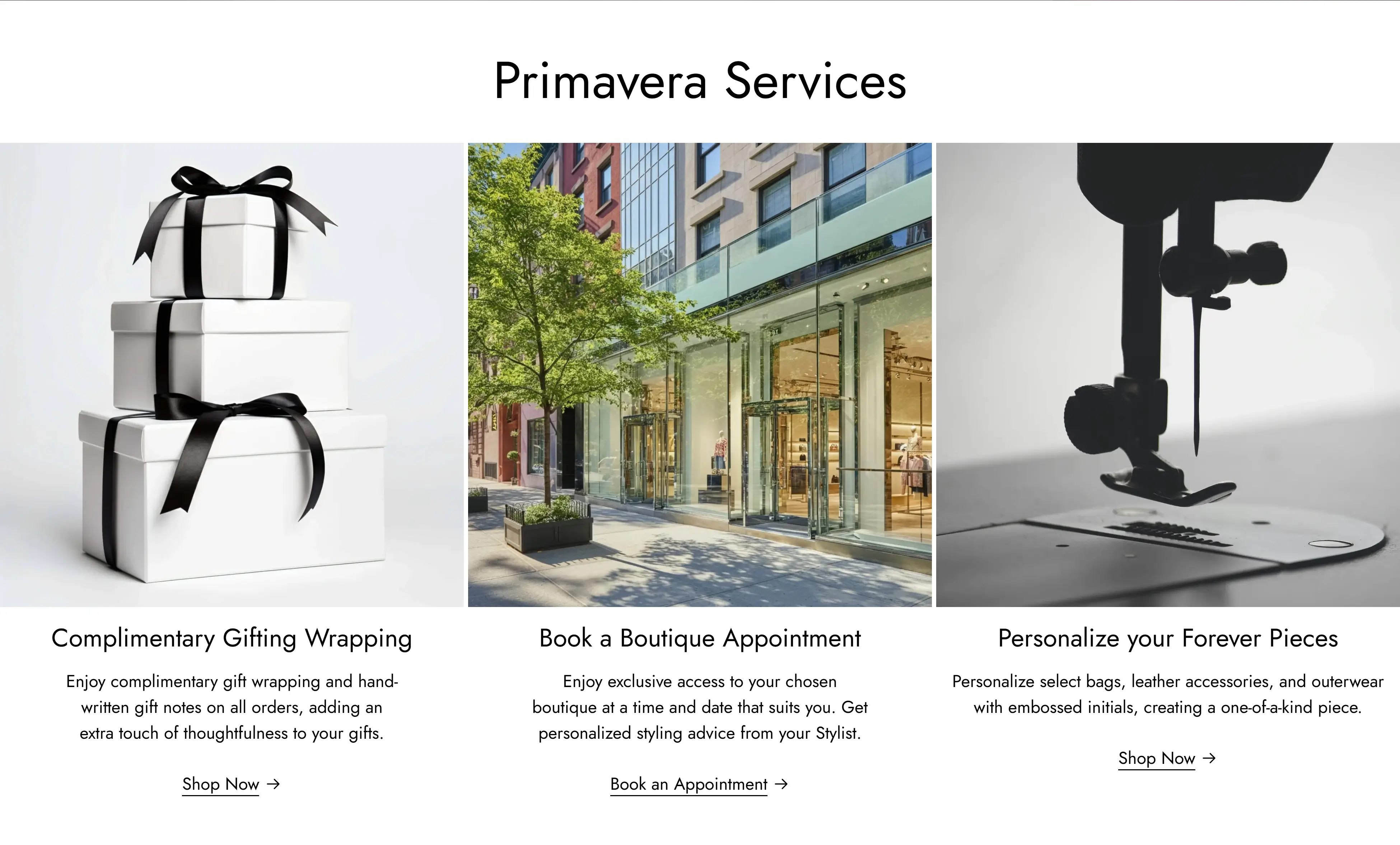
The versatility of the multicolumn section allows you to create sections such as a classic trust banner with icons and a short label, or images with a longer paragraph under them.

<div><figure><img src="/files/Yl3BsjFoY51dunvTDioq" alt=""><figcaption><p>The Composition preset features an icon with heading and text.</p></figcaption></figure> <figure><img src="/files/8yqEcHyAU2BIVDnaZ8ns" alt=""><figcaption><p>The Gaia preset features an icon with a heading.</p></figcaption></figure> <figure><img src="/files/pKzve6GFkOeHAlAg3IN1" alt=""><figcaption><p>The Savoir preset features an section heading, with each column containing an image, a heading, paragraph text and a button. </p></figcaption></figure></div>


---

# Agent Instructions
This documentation is published with GitBook. GitBook is the documentation platform designed so that both humans and AI agents can read, navigate, and reason over technical content effectively. Learn more at gitbook.com.

## Querying This Documentation
If you need additional information that is not directly available in this page, you can query the documentation dynamically by asking a question.

Perform an HTTP GET request on the current page URL with the `ask` query parameter, and the optional `goal` query parameter:

```
GET https://docs.ultramarinastudios.com/sections/multicolumn.md?ask=<question>&goal=<endgoal>
```

`ask` is the immediate question: it should be specific, self-contained, and written in natural language.
`goal` is optional and describes the broader end goal you are ultimately trying to accomplish on behalf of the user. GitBook uses it to tailor the answer towards what is most useful for that goal.

The response will contain a direct answer to the question and relevant excerpts and sources from the documentation.

Use this mechanism when the answer is not explicitly present in the current page, you need clarification or additional context, or you want to retrieve related documentation sections.